
Last Thursday, Voluntario Global gathered with a group of volunteers to reflect upon their time in Buenos Aires, thus far. Muffled sounds of rainfall and cheerful protestors, marching, or rather, dancing down Avenida de Mayo flooded the room as Voluntario Global founder, Valeria, asked the golden question: why do you choose to volunteer?
The mate made its way around the table while each volunteer shared her own unique experiences. Though the conversation may have surfaced through a varied mix of language, our thoughts remained universal. Despite the diversity among us, of both culture and passion, one particular answer, in some form or another, rang true for all. Why do we volunteer? Aside from the obvious gratification one finds through helping others, volunteer work may very well serve as the ultimate vehicle in providing, a sort of, ‘inside scoop’ on places where we might typically be considered outsiders— average tourists holding cameras, stuck behind a glaring lens.
As volunteers, we crave much more than a pretty photograph; we seek the true story behind it, as well as the chance to, if even for a moment, become part of that story. While the city of Buenos Aires certainly has no shortage in scenery, the most beautiful landmarks become meaningless without a stock of colorful people to surround it. Volunteering, whether at a kindergarten or a medical clinic, helps each of us gain an educated and enriched perspective on a culture outside of our own. And though some of us may already be moving on to new adventures, our time in Buenos Aires will always serve to remind us of the positive change that occurs, both in a community and within ourselves, when cultural barriers are broken.

After what seems to be a long period of depressing wet and damp weather, Buenos Aires will once again transform as verano or summer begins later this month! In preparation for all the fun in the sun, we’ve collected a list of 10 activities you need to check out.
1. Buenos Aires Playas: The cultural department of the government hosts these ‘urban beaches’ all over the city. Although there isn’t an updated website, take a look at information about last year’s playas urbanes program here.
2. Concert in the Park: Also through the city government are a variety of local concerts all over Buenos Aires. To see which barrios (neighborhoods) these concerts take place, check out this website.
3. Film Festivals: When the weather during the day is beautiful, so are the evenings. Bring a chair or blanket and watch some films under the stars. For information about film festivals and other events check out Vuenoz Aires.
4. Get a kilo of Ice Cream or Gelato: Nothing says welcome summer like an ice cream cone! Well in Buenos Aires you cannot go wrong when it comes to helado (ice cream) or gelato since there’s a shop on almost every city block. Remember, when ordering many portenos get as much as one kilo at a time so splurge and enjoy! For recommendations on the ‘best’ heladerias and gelaterias visit Gringo in Buenos Aires.
5. Carnival in Buenos Aires: The famous Brazilian tradition carries on in many places across the world including Buenos Aires. This February check out some of the events to celebrate.
6. Take a Bike Ride or Long Walk at the Reserve: Most people prefer to be outside when there’s nice weather so go visit the Reserva Ecológica Costanera Sur next to Puerto Mandero. This expansive area has plenty of plants, wildlife, and tranquility making you feel like your no longer in the city. We suggest renting a bike or taking a long walk around. More information can be found here.
7. Have a picnic: It’s simple, easy to do and a great shared experience. Pick a park in the city, go to the nearest market or delicatessen (deli) to get something to eat/drink, bring a blanket and invite a friend or loved one to join you!
8. Visit El Zanjón de Granados in San Telmo: When it gets to be too hot and sticky, check out the El Zanjón de Granados, the underground tunnel system in San Telmo. Learn about interesting local history and stay cool. For more information check out TripAdvisor.
9. Go to Mar de Plata: Even though this isn’t in Buenos Aires it’s still worth it going there for a weekend. During the summer season, many porteños make a trip to Mar de Plata every summer to get away and relax.
10. Day Trip to Tigre: In the northern part of Buenos Aires there’s an area called Tigre known for the proximity to the river Delta. Tigre is best on a sunny day especially to take a barca (boat) ride. Other things to do here include the nature reserve, the naval museum and walking around town. Check out this website on how to plan your trip!

Over the last two years, Rocio Belen Gonzalez Vasquez, has been a vital part of the team at Voluntario Global. Rocio says that like many things “the team is also a family,” and she has thoroughly enjoyed working with Voluntario Global. She says, “I love getting to know all who are involved with the projects and meeting volunteers from all over the world.”
Dedicated to both her education and career she is reminded of her idol, her mother. Her mother went back to college after she had started a family. She worked during the day, went to school at night, and still had time to be a supportive parent. Remembering cartoon from her childhood, where the main character had a watch that could stop time, she smiles and says, “That would be a great superpower because you never have enough time to do everything!” But with or without superhero powers, Rocio is determined to accomplish her goals and make her mother proud.
Currently, Rocio is studying for a Master’s degree in social policies. She hopes to get a position in the Argentinean government. From a young age, Rocio was inspired to raise awareness about real issues of both the past and present. Although she loves working with NGOs like Voluntario Global, her dream job is to work in the Educacion y Memoria program with the Ministerio de Educacion, training children to become human rights defenders and promoters.
Rocio does want to travel more whether or not she gets a government job. “Traveling is great, you learn so much about yourself,” she says reflecting on her first trip abroad to England. She’ll also continue to play sports and watch Argentinean films when she’s not on-the-clock. She says, “I love to play sports ever since I was a little girl… And I love Argentinean films, I like the stories they tell about real people.” Some of her suggestions include “Andres No Quiere Dormir La Siesta” and “Kamchatka.”
Her advice for the new coordinator Milena is to enjoy it, “It’s a cool job and the team you work with is amazing.” For the new volunteers she says, “It can be tough at first living somewhere new, but take advantage of opportunities. Let go of the fear!” Carpe diem Rocio!
Interview with Mina: Volunteering with the community in Buenos Aires
geschrieben von Catherine Valero
Many of the volunteers that work in the soup kitchen in Barracas, a neighbor outside of the center of Buenos Aires, come away with a sense of family. This kitchen serves families in the surrounding area and prepares food for the children of the kindergarden next door.
Over the past month I’ve had the opportunity to meet some of these volunteers including Mina, 19 year old Norwegian who has lived in Buenos Aires for over three months now. Mina came to Buenos Aires with the idea of volunteering along with studying Spanish. Back in Norway, Mina always volunteered particularly with refugees and children. She connected with Voluntario Global through her language school in Buenos Aires and the rest is history.
While working in the soup kitchen, Mina says she gains 15 grandmothers.The kitchen is run by women and Mina says, “The most inspiring thing is that these women do this voluntarily,” in addition to having other jobs to support their own families. A unique aspect of Mina’s volunteer experience is her willingness to embrace these women and their lives. She has been inducted into their own families, going to some of their homes for a meal or to watch a rugby match. She says, “It’s like my second home.”
Mina is not only committed to volunteerism while in Buenos Aires, she is also dedicated to learning Spanish. Upon her arrival, she’s lived in various housing arrangements with foreigners especially those from other Spanish-speaking countries like Columbia. She has also been taking classes with a local language school in the past month. “I studied a lot in school (in Norway) and could understand somethings but now I can say a lot more, with more speed, and I’m happier with my skills,” she says. The Spanish spoken in Buenos Aires is different, so when asked what her favorite word or phrase she say, “Como andas? Because it’s very simple but very useful and Argentine.”
In the coming week, Mina will say goodbye to the “ladies of the kitchen,” but hopes to bring the openness, warmth and love for everyone in Argentina to Norway. She says, “I hope to take back the idea of reaching out to others, the solidarity of giving back.” She plans to travel around to other countries such as Mexico and Cuba where she wants find another volunteer program that involves children. Mina has many goals for her future including, “making a difference.” She says, “Although volunteering is important, I want to make a bigger impact. I want to get a higher education studying economics to help raise funds and make structural changes” for an organization she’s passionate about. ¡Buena suerte, Mina! We can’t wait to see what you’ll accomplish!
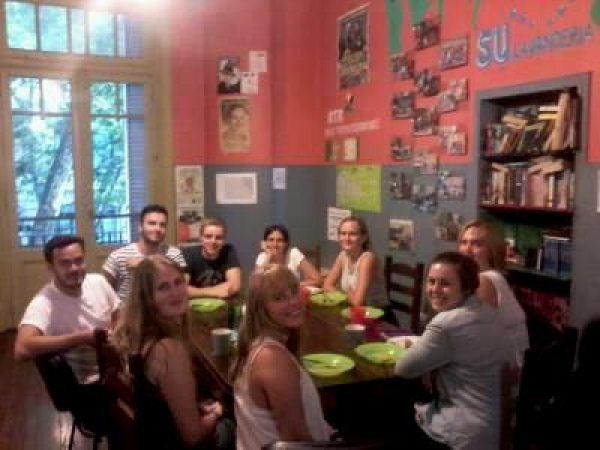
One of the unique features about being a volunteer with Voluntario Global is the sense of family. The coordinators of the organization truly value the relationship made with volunteers from all over the world and how important it is to recognize their commitment to making a difference in Buenos Aires. Aside from an occasional planned event to take a tour of Teatro Colon or playing futbol, each month volunteers are invited to the center office in Congresso on Avenida de Mayo to celebrate various accomplishments of the organization, volunteers and the projects they serve. During these meetings, volunteers have the opportunity to meet other volunteers as well as talk about anything from culture to politics.
Last week, I was fortunate to participate in “La Reunion de Voluntarios” (Volunteers Meeting). It was nice to finally meet some of the volunteers I’ve heard about but never met in person. There were nine volunteers —some new, some seasoned, two coordinators, Valeria and Milena, and two members of Voluntario Global’s Youth Committee—. We engaged in topics like political systems and candidates running in the Elections in Argentina. If you don't know by now, Argentinians are very open to discuss almost anything and politics is a particular passionate subject for many porteños, especially now.
Some of the volunteers like me, who come from a ‘well-established’ democracy such as the United States of America, are not used to discussing politics without consequences. However, the differences in opinions and ideologies at “La Reunion de Voluntarios” was educational. We had a long two-hour chat about the different governments and political ideologies – Socialism, Communism, Liberalism, Democratic, Republican, Labor, etc, and of course the candidates, Daniel Scioli and Mauricio Macri, and their vision for the future of the country in terms of the economy, employment and international and domestic trade. At the close of our reunion, I felt enriched with a new understanding of the history, culture and political climate here in Argentina and that of other countries and the volunteers currently working with Voluntario Global.
Who knows what we'll discuss next month. Stay tuned!

The EDM or electric dance music has grown from the underground scene to mainstream radio with famous djs such as, David Guetta, Deadmau5, Skrillex, Calvin Harris, Diplo, Tiesto and much more. Many of the EDM fans attend festivities throughout the year to see their favorite djs but also meet socialize with people and explore new talent together.
Creamfields started in the late 1990s in Winchester, England and since its much earned success expanded into multiple locations around the world. Creamfields Buenos Aires is not only the most attended and popular of the Creamfields festivals in South America but it also was the first Creamsfields to be organized outside of its birthplace. Celebrating 15 years, Creamfields Buenos Aires is bound to put out all the stops to make this an unforgettable event.
Located on the fareast side of Buenos Aires in the Costanera Sur ecological reserve past Puerto Maderno. Unfortunately, if you don’t have a ticket to Creamfields Buenos Aires yet the sad news for you is the event has officially SOLD OUT. However, you might be able to purchase tickets at the entrance if some do not show up. Words of advice for the novices who aren’t familiar with PLUR, trance, shuffle or anything about EDM fest-life, check out this list of tips to prepare yourself:
- Do a little research to find out what you like. For starters you should listen to some tracks by djs on the line-up.
- Take a stroll and explore. Spend 15-20 minutes in one area before moving on to the next tent/dj.
- Make sure you are aware of your surroundings which means exits, crowd surfers, debris, uneven pavement and items that might be chucked into the air at any given time.
- Stay hydrated. This is not the time for the invincible complex to kick it, be smart especially if its hot outside.
- Know where to go after the event. Whether you take public transportation or a taxi, write down your address on a piece of paper NOT your phone (might be dead by 6am the next morning).
- Bring: Backpack, Sunblock, chapstick/lip balm, money, cell phone, identification (with birthdate), water bottle, sneakers, sunglasses, gum, kandi (optional) and ear plugs.
- Most importantly, HAVE FUN!!!
Happy 15th birthday Creamfields Buenos Aires!
References: http://www.complex.com/music/2014/03/edm-festival-survival-guide/

On the taxi ride from Ezezia International Airport to downtown Buenos Aires I remember driving past many large scale murals wondering about the process to make such a piece. That was three weeks ago and since then I have been blown away by the variety of art all over the city. It’s impossible to ignore and not to appreciate the professionalism and style of such works on the busy corner of Avenida 9 de Julio, a shop in Recoleta or an alley in San Telmo. But as much as I find myself admiring these beautifully pieces, I often find myself asking the question, what does it mean?
I quickly learned on a few walking tours with Graffitimundo and more recently with Buenos Aires Street Art Tours, most of the artists understand that their works are temporary which raises an even more tantalizing question, how does that work? Over the last two decades, most of the original murals of beloved artists such as, Blu, Jaz, Primo and others still remain today. Although graffiti has been popular in political propaganda since the 1960s, street art is a fairly new phenomena in Buenos Aires. This rapid proliferation of street art in Buneos Aires is also unique compared to other parts of the world because it’s located in nearly every neighborhood. What really stuck with me was the idea that art found around the city belongs to the public therefore everyone has access to enjoy it not just the rich or those who can afford it. It’s changing the way people look at art including me!
In addition to my newfound education about how street art has set a platform for artists to express themselves about the social injustice in Argentina it’s also interesting to understand the graffiti culture as a whole. Now as I walk around the city I will take the time to stop at murals on the street with a new sense of respect. I see Buenos Aires as a giant, outdoor museum with a rich history that continues to expand. For more information and feedback about tours with Graffitimundo and Buenos Aires Street Art Tours, check out TripAdvisor.
A NEW LIFESTYLE: COFFEE AND TEA IN BUENOS AIRES (PART 2)
geschrieben von Catherine Valero
Yerba mate or more commonly used mate is native to South America and more importantly is home to Argentina. Dating back pre-colonial era, the indigenous people found trees along the rivers of Paraguay, Uruguay and Parana that were used for medical practices and later consumed as a drink. Dry leaves from these trees were believed to improve one’s health and as a ritual, drinking mate became a way of life.
Mate and Buenos Aires are in a long-term relationship that seems to keep growing. Its influence on the urban culture in Buenos Aires has transformed into a commercial enterprise. In most cafés and supermarkets you can take your pick from an assortment of brands, flavors, origin (what region it’s from) and prices. Fun fact, most Argentineans will consume up to 5kg (about 11lbs.) of mate a year!
For us gringos, the most important piece of advice I can share is to drink the entire cup of mate from the gourd. Historically this is the proper what to drink mate and any porteno will tell you the same. Typical items necessary for a complete mate experience include a gourd (traditional cup), bombilla (straw), and mate of course. Often you’ll find people all over Buenos Aires holding a gourd and bombilla but also a thermos of metal or plastic. Like serious coffee drinkers, for the mate purest a thermos gives you the opportunity to fully enjoy a daily helping of caffeine and savor the taste for a longer period of time. Yes, mate contains caffeine like most European style black teas. And similar to some coffees, mate is bitter but with qualities of green tea. Remember your manners, if you are offered mate, don’t make a weird face. Take it, drink it and pass it. Or use your words and simply say ‘no, thank you.’ The taste of mate is a bit strong and may not be for you. Not everyone from South America is a fan despite the case in Buenos Aires.
Furthermore there is a process to drink mate as I soon learned. First is wash out the mate gourd thoroughly so that there’s no residue from previous use. Next you heat water to the point before it boils, unless you prefer to use orange juice which is another method; this is typical in verano (summer) in Buenos Aires and in Paraguay. Then you fill the gourd with the mate leaves and once the water is hot, you pour into the mate gourd and viola! However, a word of caution. Depending on the type of bombilla (straw) you have if you are using hot water be VERY careful drinking to avoid burning your tongue or lips. Otherwise it’s not as fun as I found out…
If you are interested in buying your own ‘mate kit’ I suggest you start by taking a trip to your local grocery store. Get a sense of the styles, prices and other mate paraphenilla. Instead of buying something the first time, give yourself a day or so especially if you have enough time to go to a street market. On the weekends, there are many street markets in places like San Telmo, Villa Crespo and Recoleta with plenty of gourds and bombillas to choose from AND at reasonably barato (cheap) prices. While you are in Buenos Aires, no matter how long your stay you will try mate. Mate is a way for people to be social and plays a key role in bringing people together. The mate experience is one meant to be shared, so go out there make some new friends!
I ended up putting some shoes on hold, as I really could not decide which ones I would wear. I like my tango shoes simple, as it happens and black. The rest I will leave to the pros.

- If you like outdoor running, then BA doesn’t do badly. I have had some great moments out in the Bosques de Palermo ( nearest station plaza italia) where you can run, rollerblade and bike for miles. This is a really great part of town if you just want a moment to yourself, to absorb what you have seen, read and done so far; a momentary pause to give you back a boost of energy.
- I am a huge yoga enthusiast and when I came here, I found it hard to find a class that would suit me. It’s great for back problems or just to get you back in touch with your body if you are running around like a headless chicken trying to see and do everything at once. Your body needs a break, so if you have time, you should try ValleTierra on Plaza Armenia (the posher part of town but so great) where you can take an Iyengar yoga class and hang upside down for a while
- Back home, I make smoothies and juices in the morning but I don’t have a machine here, so I found a few affordable options to go and get one squeezed for me. The first is called The Factory and they are a chain in both Recoleta and Palermo that do super juices. The company was started by a venezuelan/ danish couple who moved to the city realising that they needed to inject a little health awareness into the porteno population. It worked and now a lot of people go. Another one I really like is called Mango Bambo in Recoleta and they are the dons of juice. You can literally ask for anything and they will juice it up, all the while chatting and talking to you in Spanish. Thees pit stops in the city are fun and I find it easy to strike up a conversation in these cosy spots.
- If you want to make your own healthy fare, I would suggest going to barrio chino in Belgrano where the shops are stocked with lots of products you perhaps can’t get elsewhere in the city. I have a soft spot for almond butter and they do a really good one there, along with fresh pak choi, coriander (usually a little tricky to find) and other delicious bites.
- A really lovely afternoon can be spent on the banks of the river in Puerto Madero and for the more adventurous, you can try the Reserva just behind Puerto Madero, where green space stretches for miles.
- It would almost be criminal not to mention the huge craze that BA has for Crossfit. If you haven’t tried it, I would recommend it only for the die hard amongst you. It is a series of circuits that, should you actually survive a class, will make you feel like an olympic champion. I tried it and nearly died but i can see that a lot of portenos swear by it, so there must be something to it.

VOLUNTARIO GLOBAL
Voluntario Global helps local communities by being available to discuss anything that local organizations need, and offering ideas for further change and development.
Read more...
CONTACT
Location: General Pacheco. Buenos Aires. Argentina
Email: Diese E-Mail-Adresse ist vor Spambots geschützt! Zur Anzeige muss JavaScript eingeschaltet sein!